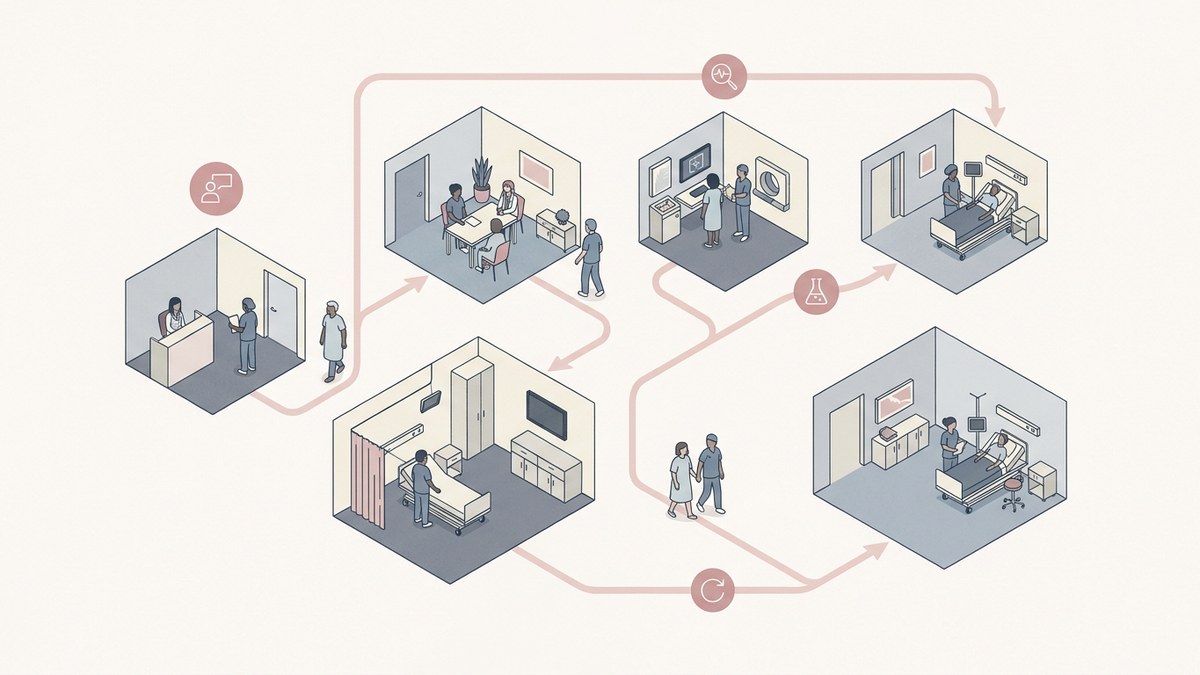
An Australian qualitative study, published in Breast Cancer Research, has reconstructed the full care journey of 32 women living with and beyond breast cancer at least two years after diagnosis, and compared it with optimal care pathway guidelines. The result is a map of fragmented trajectories: five distinct phases, thirteen sub-phases and recurring gaps between what protocols recommend and what patients actually experience.
What was already known
Clinical guidelines describe the breast cancer process as an ordered sequence of diagnosis, treatment, follow-up and, where relevant, care for recurrence and end of life. Yet patients’ real experience does not always match that script: earlier literature had already pointed to complex pathways, with successive referrals between services and moments when coordination breaks down. What was missing was a longitudinal view following the whole journey in the women’s own words.
What this work adds
The authors held semi-structured focus groups with 32 women in Australia, all at least two years past initial diagnosis, grouped by cancer type: non-metastatic, de novo metastatic, recurrent non-metastatic and recurrent metastatic. Using framework analysis, the team identified care phases and sub-phases and compared them with optimal care pathway guidelines to pinpoint what was failing and where improvement was possible.
Main results
The analysis distilled five critical phases: initial diagnosis and treatment planning, initial treatment, post-treatment care management and recovery, managing recurrent and progressive disease, and end-of-life care. Within these, thirteen sub-phases showed consistent mismatches with the guidelines. The most frequently reported problems were poor care coordination and uneven access, delayed diagnoses and navigation difficulties in metastatic cases, poor tolerance of prolonged systemic therapy, and unmet end-of-life planning needs. Yet many described fragmented care despite established guidelines.
What it means
The study suggests that quality in cancer care is not only about choosing the right drug or operation: continuity between phases and information at each transition matter as much as the treatment itself. The authors recommend targeted resources for each care phase, structured care transition protocols, and support programmes tailored to different survivor groups. For a patient, asking who coordinates the next step is a legitimate part of care; for a service, transitions are a measurable and improvable point.
Reading from the breast unit
The advanced practice nurse or case manager role, common in breast units, speaks directly to the gaps described here: someone who accompanies the patient between phases and prevents the pathway from breaking at every referral. Reviewing internal circuits — timelines, contact points and handover — is within reach of any unit.
Reference: Smith SJ, Gibson C, Moorin R, Newton J, Maxwell-Smith C. “Hurtled down a track and then thrown off”: experiences of longitudinal breast cancer care trajectories of women living with and beyond breast cancer. Breast Cancer Research, 2026. DOI