
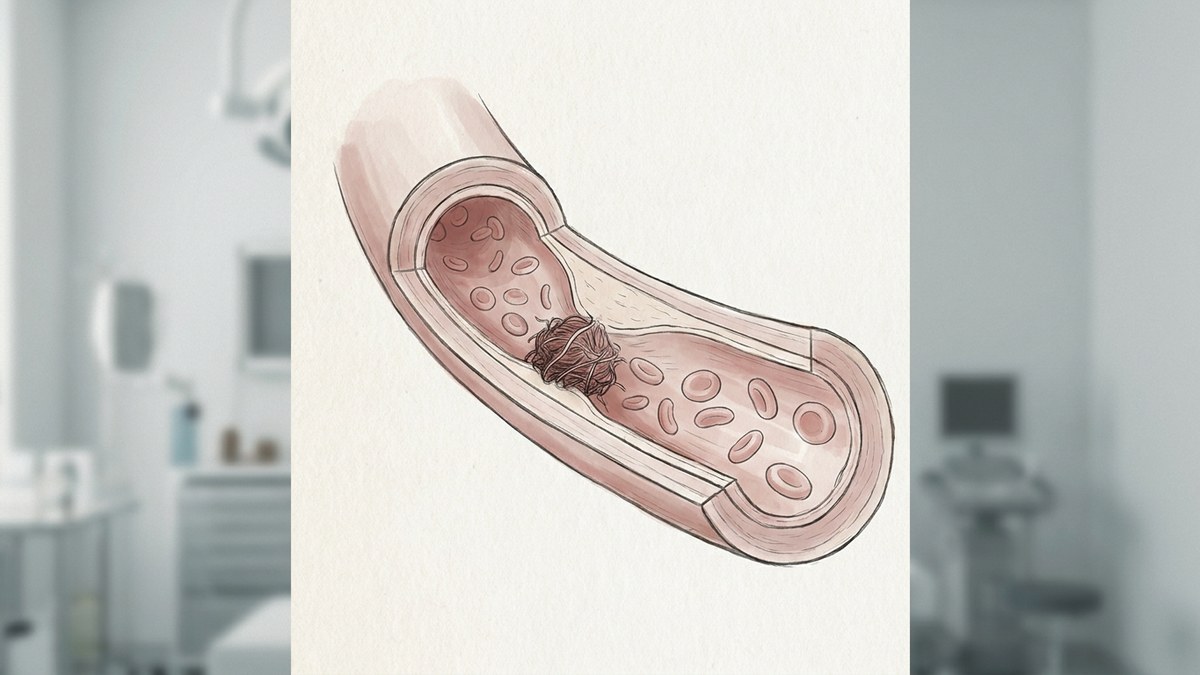
Women who have had breast cancer face more venous thromboembolism —a deep-vein blood clot or a pulmonary embolism— and that excess is concentrated above all in the first year after diagnosis. A nationwide cohort study in South Korea with more than 112,000 survivors, published in the International Journal of Cancer, shows it.
What was known
Venous thromboembolism (VTE) is a well-known and potentially serious complication in people with cancer: the tumour, surgery, catheters and some drugs all promote a prothrombotic state. In breast cancer, however, the size of that risk in the long term and the weight of each treatment had not been well quantified in a large population followed for years.
What this work adds
The authors analysed the South Korean national health insurance database between January 2010 and December 2016. They excluded women under 18, those with another cancer or a previous thrombosis, patients without surgery and incomplete records; 112,522 survivors remained, compared 1:3 with women with no history of cancer. They used a model that treats death as a competing risk (if the patient dies, the event is no longer observed) and examined several time periods and the association with each treatment modality.
Main results
Over a mean follow-up of 7.4 years, 3,621 episodes of VTE were recorded. Overall, the survivors’ risk was 68% higher than in the comparison group (subdistribution hazard ratio, sHR, 1.68; 95% confidence interval 1.61-1.75). The difference was particularly striking in the first year after diagnosis, with an almost eightfold higher risk (sHR 7.78; 95% CI 6.88-8.80). Restricted to events after the first year, the excess fell but remained significant (sHR 1.34; 95% CI 1.28-1.40), and was still elevated when follow-up started at later time points. Taxanes were associated with an increased risk (sHR 1.73; 95% CI 1.57-1.91) and anthracyclines with a more modest increase, at the borderline of significance (sHR 1.11; 95% CI 1.00-1.23).
What it means
Thrombotic risk does not disappear when cancer treatment ends and the most dangerous window is the first year. For patients, the practical message is that thrombosis is a largely preventable and treatable complication, and that symptoms such as pain and swelling in one leg or sudden shortness of breath should be reported without delay. This is an observational study: it describes associations, it does not prove that a particular treatment causes thrombosis, and its data come from a Korean population.
Reading from the breast unit
The findings support assessing thrombotic risk at diagnosis and during the first year of follow-up, especially with taxanes or anthracyclines, and making clear in the consultation which symptoms require immediate attention.
Reference: Kang J, Jung W, Kim B, Cho H, Yu J, Fradley MG, et al. Mid- and Long-Term Risk of Venous Thromboembolism Among Female Breast Cancer Survivors: A Nationwide Cohort Study. International Journal of Cancer, 2026. DOI 10.1002/ijc.70662