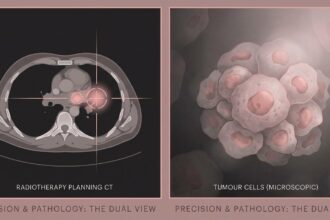


A bispecific antibody-drug conjugate, iza-bren, has shown a significant improvement in progression-free survival over chemotherapy in a phase 3 trial in patients with advanced hormone receptor-positive, HER2-negative breast cancer who had already received several prior treatments. The study, published in The Lancet, was conducted at 72 hospitals in China.
What was known
Patients with HR+/HER2- breast cancer whose disease progresses after endocrine therapy, CDK4/6 inhibitors and one or two lines of chemotherapy have few effective options left. Antibody-drug conjugates (ADCs) have opened a new therapeutic path in this setting, but the search for better targets and combinations continues.
What this work adds
iza-bren is a first-in-class bispecific conjugate that binds both the epidermal growth factor receptor (EGFR) and HER3, carrying a topoisomerase I inhibitor payload. The PANKU-Breast01 trial is a randomised, open-label, multicentre phase 3 study in which 383 patients were assigned to iza-bren or to physician’s choice chemotherapy (eribulin, vinorelbine, gemcitabine or capecitabine). All participants were women, with a median age of 54 years.
Main results
At a median follow-up of 15.2 months, progression-free survival assessed by blinded independent central review was 8.2 months with iza-bren versus 4.0 months with chemotherapy (hazard ratio 0.41; 95% confidence interval 0.33-0.53; p less than 0.0001). Grade 3 or higher treatment-related adverse events occurred in 85% of patients in the iza-bren group and 66% in the chemotherapy group, and were mostly haematological. In the iza-bren group, 73% received platelet-elevating agents, 15% needed platelet transfusion and 10% received a blood transfusion; two patients died from treatment-related adverse events. Overall survival data remain immature and no overall survival benefit has been established.
What it means
The authors conclude that iza-bren could become a new treatment option for this population in China, and stress the need to evaluate it in other countries and in earlier lines of therapy for HER2-negative breast cancer. The improvement in disease control comes with a substantial haematological toxicity burden, which conditions its use in everyday practice.
Reading from the breast unit
Bringing bispecific conjugates into practice requires breast units to tighten patient selection and the management of haematological toxicity, with transfusion support and close blood monitoring. The results also remind us that overall survival remains the decisive endpoint in breast oncology, while progression-free survival is an earlier signal that still has to be confirmed.
Reference: Lan B, Shi Y, Shao X, Wu F, Wang S, Xie W, et al. Izalontamab brengitecan for HR+/HER2- breast cancer in China (PANKU-Breast01): a randomised, phase 3 trial. The Lancet, 2026. DOI