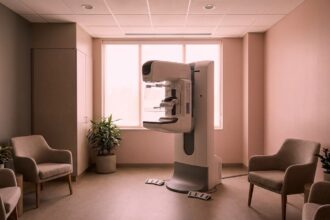
The US Preventive Services Task Force (USPSTF) has updated its recommendation on breast cancer screening: it now advises a mammogram every two years for all women aged 40 to 74 at average risk. The change brings the start of screening forward by a decade compared with the previous recommendation.
What was known
Breast cancer is the second most common cancer and the second leading cause of cancer death among US women. In 2023, an estimated 43,170 women died of the disease. Incidence is highest in non-Hispanic White women, while mortality is highest in non-Hispanic Black women. Until now, US guidelines placed the start of screening at age 50, with individual decisions between 40 and 49.
What this work adds
To revise its position, the task force commissioned a systematic review comparing different mammography-based screening strategies: the age to start and stop, the screening interval, the modality, the use of supplemental imaging and the personalisation of screening. The aim was to assess effects on the incidence of and progression to advanced breast cancer, on morbidity, and on breast cancer-specific and all-cause mortality. Collaborative modelling studies complemented the review. The target population is cisgender women and all other persons assigned female at birth, aged 40 or older, at average risk of breast cancer.
Main results
The USPSTF concludes with moderate certainty that biennial screening mammography in women aged 40 to 74 has a moderate net benefit. By contrast, it finds the evidence insufficient to determine the balance of benefits and harms of screening in women aged 75 or older. Evidence is also insufficient for supplemental screening with breast ultrasound or magnetic resonance imaging in women with dense breasts and an otherwise negative screening mammogram. The final recommendation is biennial mammography from 40 to 74 years (grade B), while for women over 75 and for supplemental screening the task force issues an I statement of insufficient evidence.
What it means
The document does not introduce a new test; it rearranges the screening calendar according to the available evidence. Widening the range from 40 to 74 aims to detect tumours at a stage when treatment may be more effective, while accepting more false positives and additional tests. The absence of a recommendation for women over 75 and for supplemental screening does not mean these practices are useless, but that current data cannot establish a clear balance of benefits and harms; in those situations, decisions should be individualised with the medical team.
A view from the breast unit
A change of this kind has direct organisational consequences: more women inside the screening programme, the need to keep waiting times for reading and for additional tests reasonable, and clear pathways for communicating results. Breast units in Spain work within their own population-based programmes, so this recommendation is international context rather than an instruction that can be applied directly to the Spanish health system.
Reference: US Preventive Services Task Force. Screening for Breast Cancer: US Preventive Services Task Force Recommendation Statement. JAMA, 2024. DOI