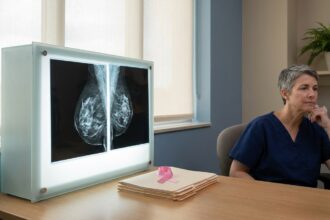
Artificial intelligence (AI) has entered oncology with more than 5,000 peer-reviewed studies a year, but its clinical maturity varies widely. A review comparing 18 tumour types places breast cancer, with prostate cancer, at the most advanced level, with FDA-cleared tools for screening mammography and digital pathology; even so, no randomised trial has shown that they reduce mortality.
What was known
Most evidence on AI in oncology comes from retrospective, single-institution studies using curated data that differ from real practice. The gap between algorithmic performance and patient benefit was recognised, but had not been measured comparably across tumours.
What this work adds
A structured narrative review of PubMed/MEDLINE, Embase, IEEE Xplore and the Cochrane Library, plus regulatory documents (FDA 510(k) decisions, CE technical files and ClinicalTrials.gov). Only studies applying AI to a defined oncological task, with explicit performance evaluation and human-derived data, were included. Quality was assessed with QUADAS-2, PROBAST and Cochrane RoB 2, and each application was graded on a five-tier translational readiness framework (T0-T4) based on the NIH spectrum and the CONSORT-AI and SPIRIT-AI guidelines.
Main results
Breast and prostate cancer occupy tier 1: several cleared tools for mammographic screening and digital pathology, validated prospectively and across institutions, but without randomised evidence of lower mortality. Tier 2 (lung, liver, melanoma) has regulatory milestones and disparities between subgroups; the paper cites 20.7% specificity for a melanoma AI tool in primary care. In tier 3 (colorectal, glioma, pancreatic, ovarian) computer-aided detection increases adenoma detection, yet a meta-analysis of 18,232 patients across 21 randomised trials showed no improvement in advanced neoplasia or cancer incidence. Tiers 4 and 5 cover tumours with single-centre results (gastric, cervical, bladder, endometrial) or structural barriers (haematological, sarcoma, paediatric).
What it means
Diagnostic accuracy is no substitute for health benefit: tools with high sensitivity and specificity have repeatedly failed to reduce mortality, overdiagnosis or procedural harm. The authors warn that these systems may amplify inequities when trained on unrepresentative populations, and propose three shifts: post-market outcome surveillance as a condition of approval, trials with patient-centred endpoints, and investment in data governance and regulatory pathways accessible to low- and middle-income countries.
Reading from the breast unit
For a unit considering AI in screening or pathology, the practical reading is to ask for prospective external validation performed outside the developing centre, to define in advance which clinical outcome will be measured (interval cancers, recalls, reading workload), and to audit performance across population subgroups before generalising its use.
Reference: Kuchana SK, Repalle UK, Alahari NV, Kondamuri M, Manduva SK, Vanguru RV, et al. Artificial Intelligence in Oncology: A Comprehensive Cross-Cancer Translational Readiness Analysis Across 18 Malignancies. Cancers, 2026. doi:10.3390/cancers18101543