

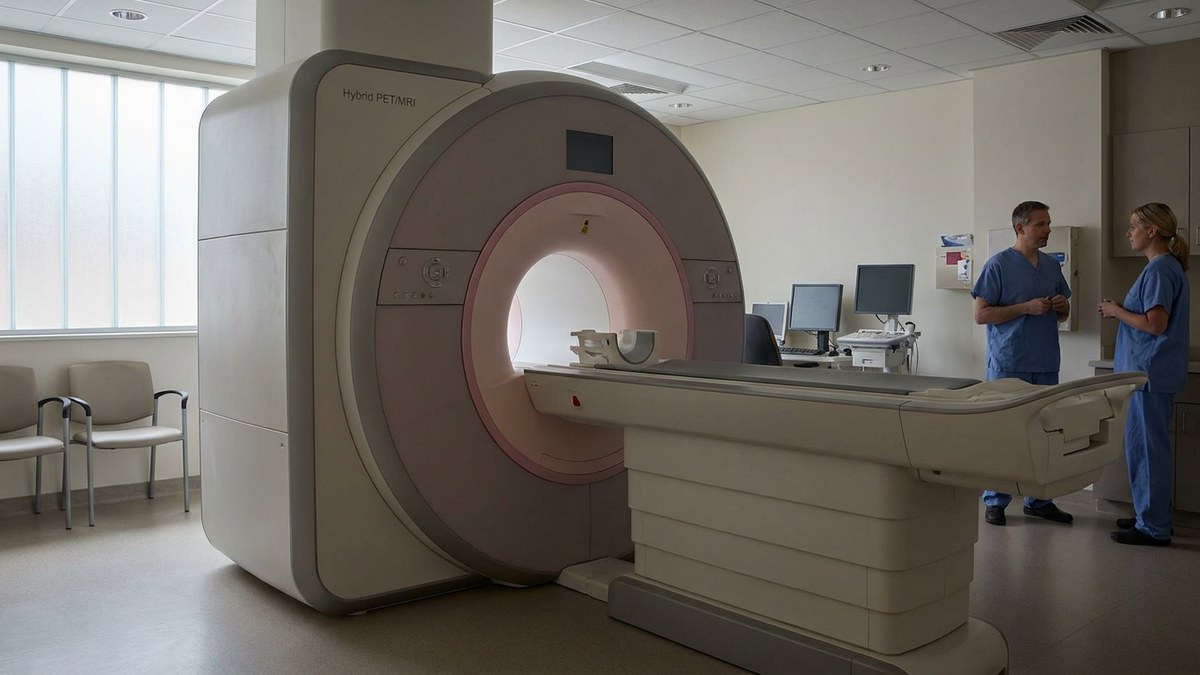
A prospective study at San Raffaele University Hospital in Milan concludes that adding an FDG PET/MRI scan before surgery changes the treatment strategy in nearly one in three patients with early breast cancer. The work, a substudy of a single-centre trial, analysed 264 cases and confirms the weight of the scan in the multidisciplinary team’s decisions, although its moderate accuracy calls for caution against overtreatment.
What was known
Accurate staging at diagnosis is essential for choosing treatment and estimating prognosis in early breast cancer. [18F]FDG PET/MRI is a hybrid technique that assesses locoregional disease and possible metastatic spread in a single scan. Little was known, however, about how much this information changed clinical decisions before surgery.
What this study adds
This is an unplanned substudy of a prospective, interventional, single-arm trial (SNB vs PET/MRI 2, NCT04829643) conducted between July 2020 and April 2024. It included 264 patients with early breast cancer scheduled for primary surgery who underwent an additional preoperative PET/MRI. The primary objective was to measure in how many patients the treatment plan changed after the scan was discussed by the multidisciplinary team; the secondary objective was to assess its ability to detect multifocal disease compared with standard imaging.
Main results
PET/MRI led to a change in the treatment plan in 30.7% of patients (81 of 264; 95% confidence interval: 25.4%-36.5%). The surgical approach was altered in 23.9% (63 of 264), 4.9% (13 of 264) received primary systemic therapy and 1.9% (5 of 264) were referred for systemic therapy alone. For multifocal disease, the scan showed a sensitivity of 61.7%, specificity of 84.9%, positive predictive value of 49.2% and negative predictive value of 90.4%. Combined with standard imaging, the positive predictive value rose to 63.6% and sensitivity was 29.8%.
What it means
The authors conclude that PET/MRI substantially influences therapeutic decisions in early breast cancer, changing management in nearly one third of patients. MRI was highly informative for detecting multifocal disease, whereas the added value of PET may relate mainly to integrated axillary and distant staging. The researchers themselves warn that diagnostic accuracy is moderate and that caution is needed to avoid overtreating findings that are not subsequently confirmed.
A view from the breast unit
The study reinforces the role of the multidisciplinary team as the place where imaging becomes concrete decisions, but it reminds us that no test replaces clinical judgement or pathological confirmation. Introducing more sensitive techniques requires clear protocols for discussing and verifying findings.
Reference: Di Micco R, Corona SP, Bagnardi V, Riccardi S, Canevari C, Gallivanone F, et al. From staging to changing strategy: [18F]FDG PET/MRI’s impact on treatment planning in early breast cancer. European Journal of Cancer, 2026. DOI