
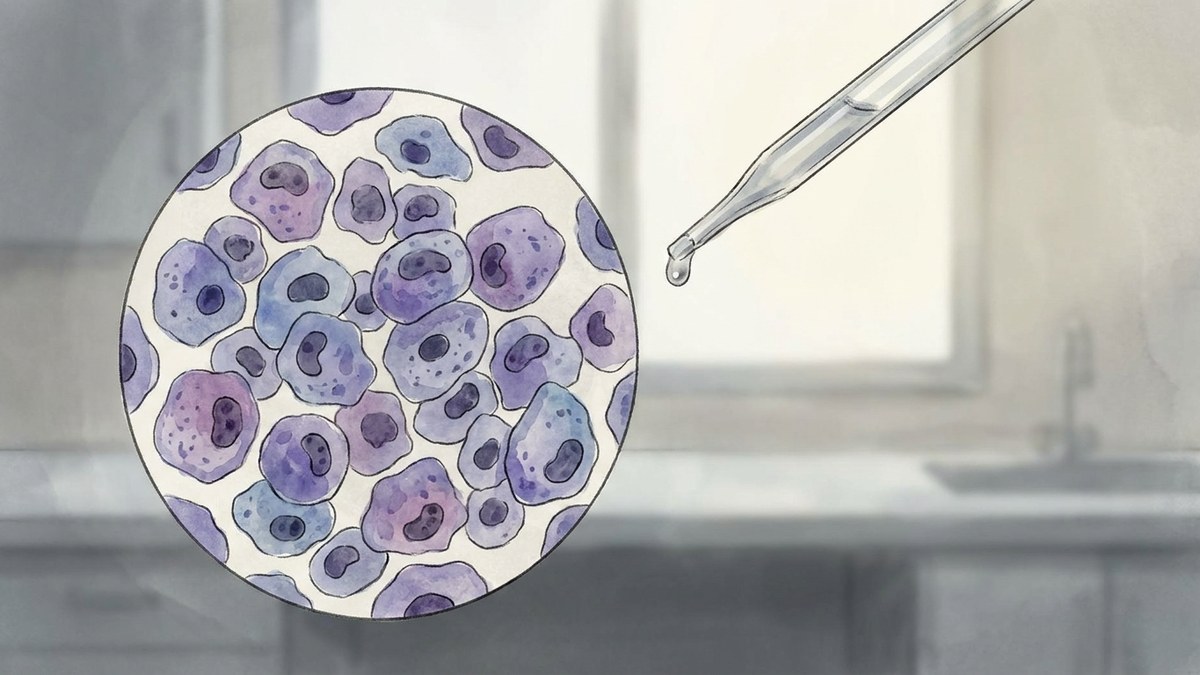
When a tumour does not disappear completely after the chemotherapy given before surgery, pathologists re-examine the sample and sometimes find that the receptors have changed. A retrospective study of 338 patients concludes that these changes, although frequent, do not on their own predict outcome: what makes the difference is how the tumour’s proliferation, measured by Ki-67, responds.
What was known
Neoadjuvant chemotherapy exerts pressure on tumour biology and can alter the expression of oestrogen receptors (ER), progesterone receptors (PR) and HER2 in residual disease. Guidelines recommend re-biopsying that residual tumour to guide adjuvant therapy, but it was still debated whether these biomarker changes mean a genuine worsening of prognosis or an adaptation that can be managed by adjusting treatment.
What this work adds
The authors retrospectively reviewed 338 patients with invasive breast cancer and residual disease after standard neoadjuvant chemotherapy and curative-intent surgery. In each patient they compared the status of ER, PR, HER2 and Ki-67 before and after treatment; they adapted adjuvant therapy according to the residual tumour profile — including targeted therapy for those who acquired HER2 positivity — and analysed survival with Cox regression models. The series comes from a single university centre.
Main results
Biomarker conversion was substantial: 13.9% of tumours changed in ER, 18% in PR and 27% in HER2. Despite that frequency, the receptor changes — both losses and gains — did not translate into statistically significant differences in disease-free survival or overall survival (all p values above 0.05). Ki-67 dynamics did emerge as a significant independent prognostic factor: patients whose proliferation moved from high to low (Ki-67 below 18%) had better disease-free survival (HR 0.45; 95% CI 0.24-0.84; p = 0.011) and better overall survival (HR 0.36; 95% CI 0.15-0.85; p = 0.020) than those with persistent high expression.
What it means
The practical reading is that a Ki-67 that stays high after neoadjuvant chemotherapy identifies a group with a worse prognosis and could be the main criterion when deciding to intensify adjuvant therapy, ahead of receptor conversion. Biomarker conversion by itself does not appear to doom the patient if treatment is adjusted to the new profile. This is a retrospective, single-centre study: it describes associations, not causation, and the findings should be confirmed in prospective series.
Reading from the breast unit
For a breast unit the message is twofold: re-biopsy of the residual tumour still matters for choosing targeted therapy, but it should be read together with the evolution of proliferation. A persistently high Ki-67 in the surgical specimen is a signal to take into account during follow-up.
Reference: Elçiçek ÖF, Çavdar E, Yalıcı Ö, Gedik E, Öznur M, Bilen YG, et al. Ki-67 Dynamics and Biomarker Conversion as Prognostic Factors in Residual Breast Cancer. Asia-Pacific Journal of Clinical Oncology, 2026;22(6):808-816. DOI 10.1111/ajco.70134