

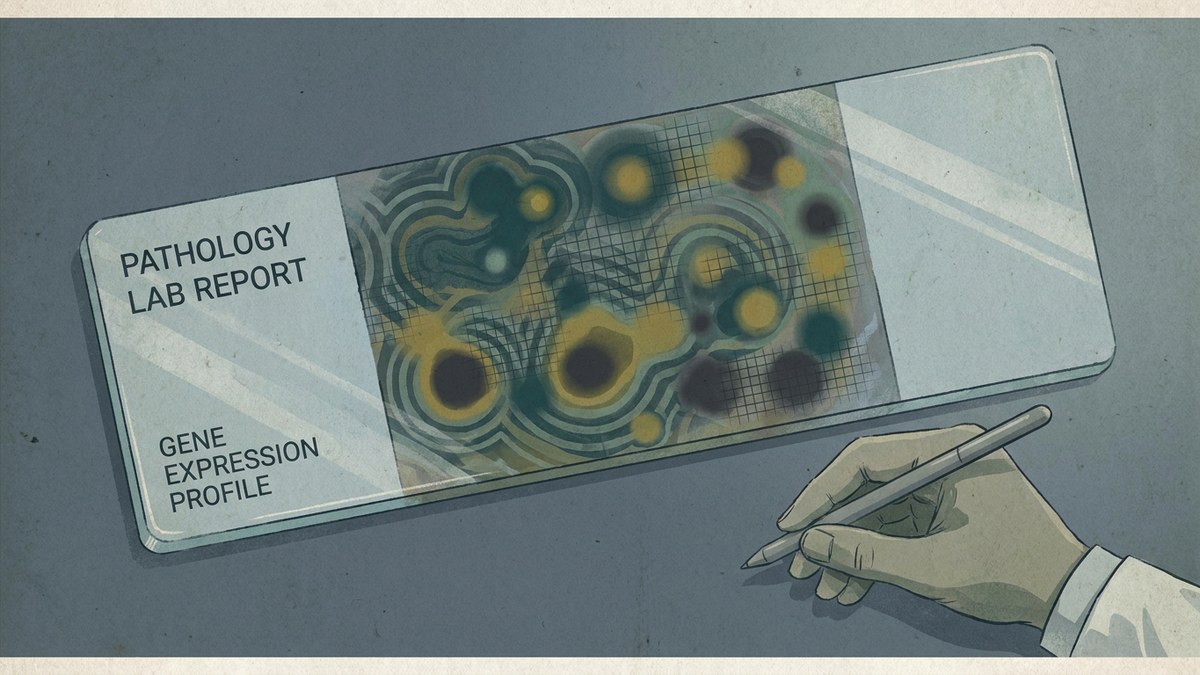
A Swedish team has developed deep learning models that combine tumour gene expression with clinical data available before surgery to estimate whether the sentinel lymph node contains macro-metastasis in women with early breast cancer. The best model significantly improved prediction compared with using preoperative clinical information alone.
What was known
Sentinel lymph node biopsy is part of the standard surgical treatment of early breast cancer, but not every patient benefits from it: in many cases the node is free of tumour and the procedure adds morbidity without providing information that changes treatment. Identifying before surgery which patients are at low risk of nodal involvement would help select who should undergo the procedure and who need not.
What this work adds
The authors retrospectively analysed 6,836 patients from the Swedish SCAN-B registry with invasive breast cancer staged T1-T2 and no clinically detectable nodal involvement, all operated as primary treatment. They developed three deep learning models — a multilayer perceptron, a pathway-informed sparse neural network and a transformer — on a development set of 4,625 patients and evaluated them in an independent test set of 2,211 patients against an XGBoost benchmark. Alongside gene expression, the models used clinical variables available before surgery.
Main results
The transformer model was the best at modelling gene expression and required the fewest pre-selected genes. In the independent test set, combining preoperative clinical data with gene expression significantly improved the prediction of sentinel lymph node macro-metastasis compared with clinical data alone, with a ROC area under the curve of 0.693 versus 0.596. The authors also highlight the agreement observed between biopsy and surgical specimen samples, which supports the feasibility of future biopsy-based preoperative applications.
What it means
The work suggests that the molecular information already obtained from the diagnostic biopsy can be exploited far more fully with artificial intelligence tools, and that doing so alongside routine clinical data improves the estimation of nodal risk. This is a retrospective development and validation study, not a clinical trial: its results do not yet change clinical practice, but point to a path for future prospective studies testing whether such models can reduce unnecessary axillary surgery without compromising oncological safety.
A view from the breast unit
Preoperative prediction models matter to breast units because they touch on one of their most routine decisions: who undergoes sentinel lymph node biopsy and who might avoid it. Any change in that direction would require prospective validation in local populations, since these models are trained on specific registries and technologies and their performance may not transfer directly to other settings.
Reference: Zhang D, Staaf J, Bendahl PO, Dihge L, Ohlsson M, Sjöström M, et al. Multimodal Gene Expression Deep Learning for Predicting Sentinel Lymph Node Macro-metastasis in Early Breast Cancer: Development and Validation in the SCAN-B Cohort. Clinical Cancer Research, 2026. DOI