

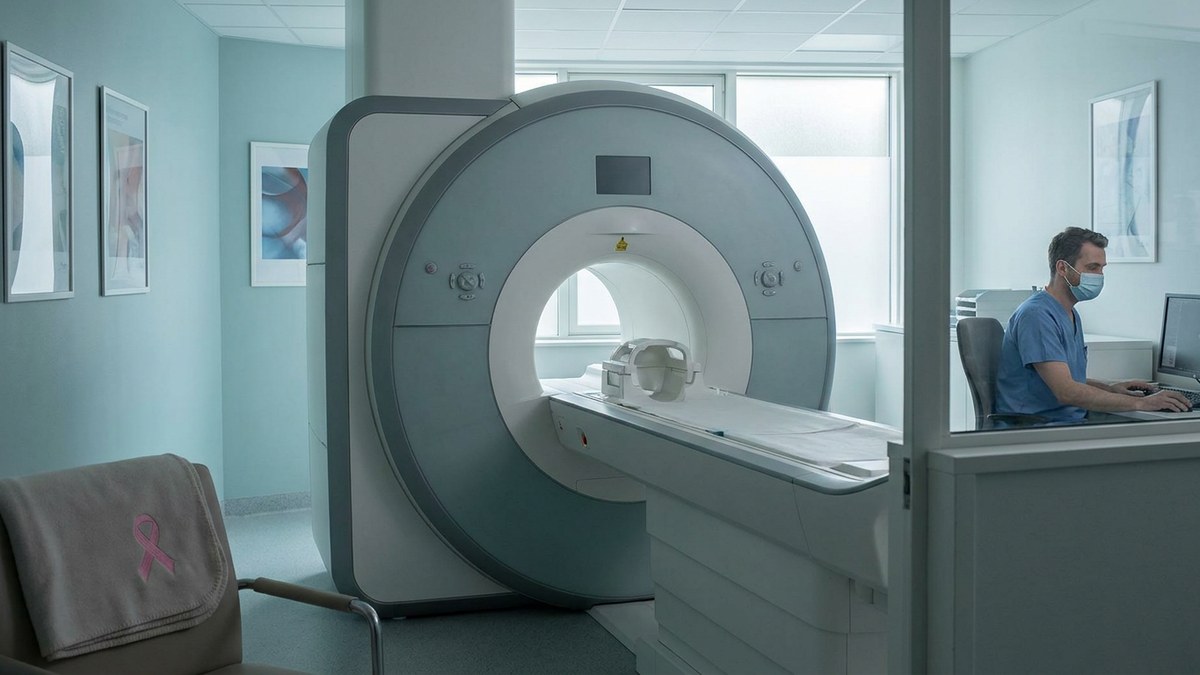
Screening breast MRI finds far more early-stage breast cancers than mammography, but it does not clearly reduce the appearance of advanced cancers and it multiplies by more than five the number of biopsies that turn out to be benign. That is the conclusion of a large cohort study at US imaging facilities.
What was known
Digital mammography and tomosynthesis are the reference screening tests in the general population. For women at elevated risk, adding MRI is often considered because it is more sensitive. The question is whether that sensitivity means fewer advanced cancers, or only more findings, more work-up and more unnecessary biopsies.
What this study adds
A cohort study from the Breast Cancer Surveillance Consortium covering 172,865 examinations in 105,532 women aged 40 to 74 at US facilities between 2005 and 2021. Women who had a screening MRI, with or without a prior mammogram, were compared with those who had only digital or tomosynthesis mammography. Advanced cancer risk was classified with the consortium’s own model into two levels. Three outcomes were measured per 1,000 examinations: advanced cancer, screen-detected early-stage cancer and false-positive biopsy recommendation, adjusted for age, prior biopsy and breast density.
Main results
With mammography, the intermediate to high risk group had significantly higher rates than the low to average risk group of advanced cancer (0.6 versus 0.3 per 1,000), screen-detected early-stage cancer (2.8 versus 1.8) and false-positive biopsy (18.1 versus 14.7). In the MRI group none of the three rates differed between risk levels. Against mammography, MRI did not change the advanced cancer rate (difference 0.6; 95% CI -0.4 to 1.6) but raised screen-detected early-stage cancer sharply (11.4 versus 1.8 in the low to average group and 10.3 versus 2.8 in the intermediate to high group) and false-positive biopsies (93.3 versus 14.7 and 94.0 versus 18.1 per 1,000). Women who had repeat rather than first MRIs had fewer advanced cancers (0.4 versus 2.0).
What it means
MRI brings diagnosis forward, but on its own it does not show that it prevents the most aggressive tumours, and its cost in benign biopsies is high: roughly one in eleven MRIs led to a biopsy recommendation that did not confirm cancer. The benefit in advanced cancer appeared only with repeat MRI screening, suggesting that continuity matters more than a single examination. The authors ask that women at elevated risk discuss this option with their physician, without extending it to the general population.
Reading from the breast unit
For a breast unit the point is mainly organisational: an MRI programme requires scheduling capacity, specialist reading and a swift pathway for second reads and biopsy, because the volume of benign biopsies is far higher than with mammography. It also demands clear explanation of a doubtful finding and sustained follow-up over time.
Reference: Kerlikowske K, Abraham L, Zhu W, Sprague BL, Tosteson ANA, Aiello Bowles EJ, et al. Magnetic Resonance Imaging and Mammography Outcomes by Advanced Breast Cancer Risk. JAMA Network Open, 2026. DOI




