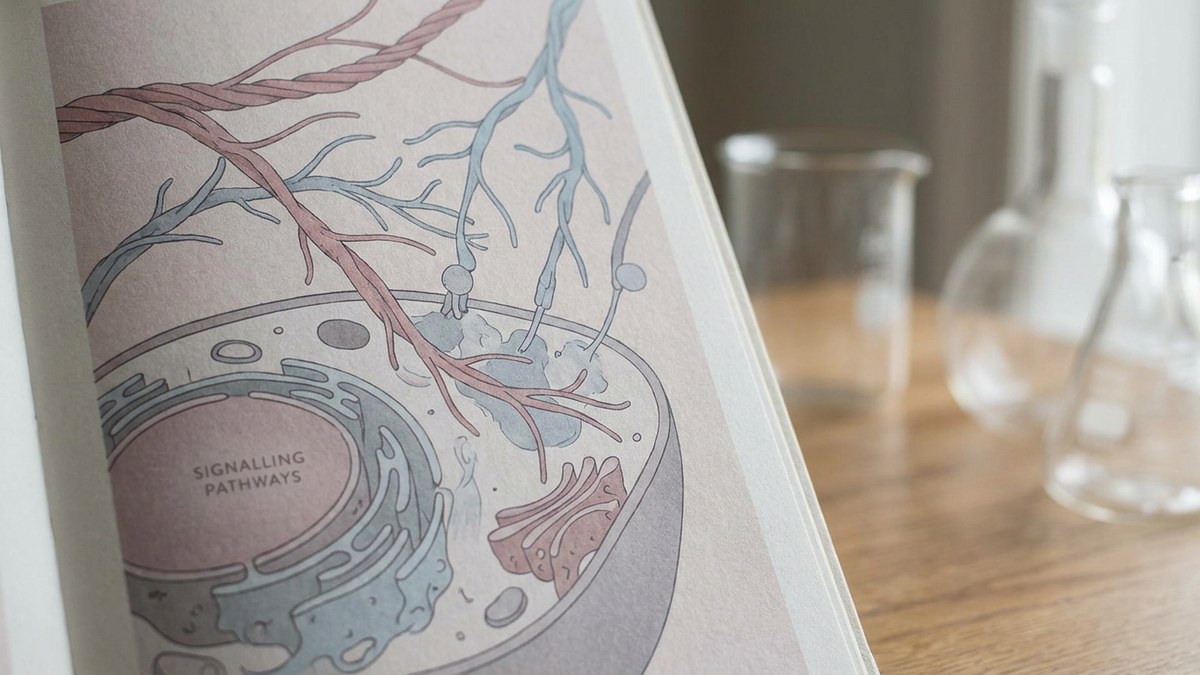
Hormone receptor-positive, HER2-negative breast cancer (HR+/HER2-) does not depend on a single signalling route. A review in European Journal of Cancer describes how the estrogen receptor (ER) talks with the PI3K-AKT-mTOR pathway, and how both converge on the cyclin D-CDK4/6-RB-E2F machinery that governs the G1-to-S transition of the cell cycle. Cyclin E-CDK2 can reinforce that machinery or bypass it once resistance emerges. The authors read the recent wave of drugs not as a catalogue but as attempts to hit one interdependent system.
What was known
Advanced luminal disease has been tackled by blocking the estrogen axis, and recent years have asked which circuits keep the tumour going when that blockade stops being enough. The review asks how to fit the new options together without losing sight of tolerability under chronic treatment.
What this work adds
It is not a clinical trial and brings no patients of its own: it synthesises recent evidence and proposes a framework around three ideas. First, ER pharmacology has diversified into mechanistically distinct classes. Second, the constraint has not been a shortage of targets but the tolerability ceiling of chronically blocking several nodes. Third, patient selection is moving towards genomically defined subgroups.
Main findings
On the first axis, the review gathers selective estrogen receptor modulators (SERMs), complete antagonists (CERANs), covalent antagonists (SERCAs), oral receptor degraders (SERDs), PROTAC degraders and KAT6 inhibition. The most consistent signal concentrates in the ESR1-mutant setting, which they read as a lesson in biomarker-gated development. On the second, mutant-selective PI3Kα inhibitors and CDK4- and CDK2-selective agents are defined less by new targets than by the selectivity that lifts that ceiling. On the third, selection shifts from clinicopathological categories to genomic subgroups assessed on tissue and/or circulating tumour DNA (ctDNA), which would also allow dynamic monitoring and early switching in selected scenarios.
What it means
The proposal is to use the current taxonomy of resistance as a roadmap: durable, tolerable, biomarker-guided vertical blockade of the luminal axis. The question moves from “which drug comes next” to “which resistance mechanism does this tumour carry, and which combination covers it without unnecessary toxicity”. It is a framework for ordering decisions, not a clinical recommendation.
Reading from the breast unit
Applying it requires three processes to run smoothly: prompt access to molecular testing on tissue or ctDNA, close coordination with pathology and the laboratory, and committees that review line changes against consistent criteria. The article measures none of these; they are organisational consequences of its proposal, not findings of the study.
Reference: Caltavituro A, Giordano A, De Angelis C, Buonaiuto R, Canzian J, Torres-Marcén M, et al. Drugging the luminal axis end to end: A review of next-generation endocrine and targeted therapies in HR+/HER2- metastatic breast cancer. European Journal of Cancer, 2026. DOI