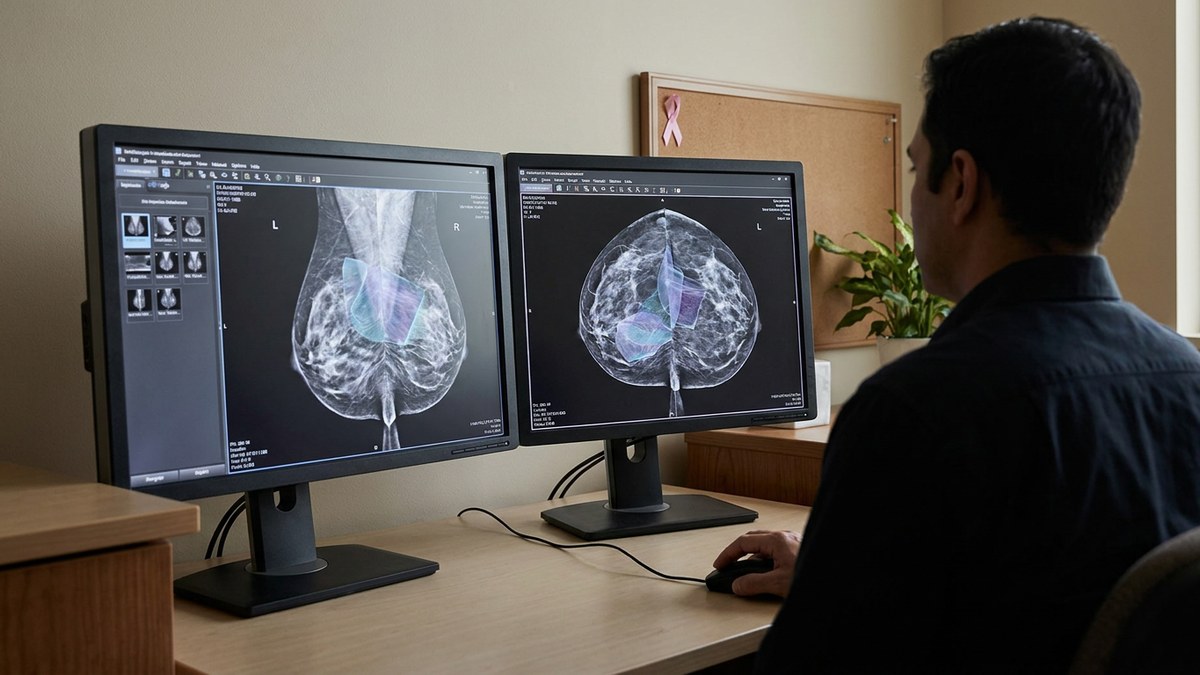
A deep learning model trained on more than twelve thousand breast MRI examinations can assign a BI-RADS category automatically, but in an independent external validation its ability to tell malignant from benign lesions fell short of specialist radiologists. The authors frame the tool as possible support for the workflow, not as a substitute for medical judgement.
What was known
MRI is the most sensitive imaging modality for detecting breast cancer, but reading it is time-consuming and requires radiologists with specific breast experience. Artificial intelligence has been proposed as an aid for that reading; what was missing, however, was robust external validation in centres and on equipment different from those used for training, which is precisely what shows whether a tool works outside its home environment.
What this work adds
The authors developed a deep learning model with 12,421 breast MRI examinations acquired between 2012 and 2024 at three institutions, on 1.5-T and 3-T scanners using dynamic contrast-enhanced protocols. The model was trained using the BI-RADS categories assigned by radiologists as reference. It was then evaluated on an independent external cohort: 158 examinations from an outpatient imaging centre, collected over six months and acquired with different hardware and protocols. The task was to discriminate malignancy from benignity, comparing the model with expert radiologist assessment through ROC curve analysis and the DeLong test.
Main results
The validation cohort included 21 malignant and 137 benign cases. Radiologist assessment reached an area under the ROC curve of 0.913 (95 % confidence interval: 0.857-0.952), while the AI model obtained 0.767 (0.693-0.830). The difference was 0.146 and was statistically significant (p = 0.0001). At a BI-RADS threshold above 3, the model classified 54.7 % of benign examinations as low risk, with a negative predictive value of 97.4 %.
What it means
The study does not currently support letting such a system read MRIs unsupervised: on data from another centre and other scanners, the AI discriminated less well than radiologists. The other side of the balance is more interesting: at one specific threshold it kept high sensitivity and flagged more than half of benign studies as low risk, with a high negative predictive value. That points to a possible role as a pre-read or second-read filter to ease workload, but the authors themselves warn that only a prospective study can show whether safely setting those studies aside actually improves the care pathway.
Reading from the breast unit
For a unit that performs screening MRI in high-risk patients or follow-up after treatment, the practical question is not whether AI beats the radiologist but whether it can order the reading list without letting cancers through. This work moves the conversation in that direction — local validation and cautious implementation — rather than towards replacing double reading.
Reference: Brader P, Spick C, Szolar D, Preidler K, Polanec SH, Prantl M, et al. Development and external validation of a deep learning-based BI-RADS prediction model for breast MRI. European Journal of Radiology, 2026. DOI