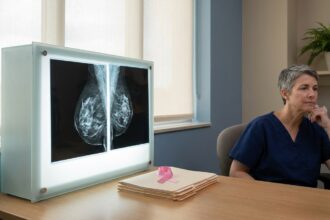
The randomised MASAI trial, conducted in Sweden with more than 80,000 women, concludes that artificial intelligence (AI)-supported breast screening detects a similar number of cancers to standard double reading by radiologists, while reducing the screen-reading workload by 44.3%.
What was known
Retrospective studies had suggested that artificial intelligence could improve mammography screening accuracy and ease radiologists’ workload, but no randomised trial had yet evaluated this strategy within a real screening programme. Prospective evidence on its clinical safety was therefore lacking.
What this work adds
This is a randomised, controlled, population-based, non-inferiority trial conducted at four screening sites in Sweden. Participants were women aged 40-80 years eligible for mammography screening, including general screening at 1.5-2-year intervals and annual screening for those with moderate hereditary risk of breast cancer or a history of the disease. Women were randomly allocated 1:1 to AI-supported screening or standard double reading without AI. The AI system provided an examination-based malignancy risk score on a 10-level scale that triaged examinations to single reading (scores 1-9) or double reading (score 10). This clinical safety analysis was prespecified after 80,000 women were enrolled.
Main results
Between April 2021 and July 2022, 80,033 women were randomly assigned. The median age was 54 years. AI-supported screening among 39,996 participants detected 244 cancers, with 861 recalls and 46,345 screen readings. Standard screening among 40,024 participants detected 203 cancers, with 817 recalls and 83,231 readings. Cancer detection rates were 6.1 per 1,000 in the AI group (above the lowest acceptable safety limit) and 5.1 per 1,000 in the control group, a ratio of 1.2 (95% CI 1.0-1.5; p=0.052). Recall rates were 2.2% and 2.0%, and the false positive rate was 1.5% in both groups. The positive predictive value of recall was 28.3% with AI and 24.8% in the control group. In the AI group, 184 of 244 cancers (75%) were invasive and 60 (25%) were in situ; in the control group, 165 of 203 (81%) were invasive and 38 (19%) were in situ. Screen-reading workload fell by 44.3%.
What it means
The findings indicate that using AI in mammography screening is safe, maintaining cancer detection comparable to standard double reading while substantially reducing radiologists’ reading workload. The trial was not halted, and the primary endpoint — the interval cancer rate — will be assessed in 100,000 enrolled participants after two years of follow-up, so long-term confirmation is still pending.
A breast unit perspective
For a breast unit, the reduction in reading workload matters organisationally, as it could free up radiologist time and staffing. Any real-world adoption would nonetheless require local validation protocols, team training and close monitoring of screening programme quality indicators.
Reference: Artificial intelligence-supported screen reading versus standard double reading in the Mammography Screening with Artificial Intelligence trial (MASAI): a clinical safety analysis of a randomised, controlled, non-inferiority, single-blinded, screening accuracy study. The Lancet. Oncology, 2023. DOI