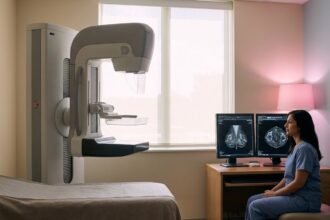
A Dutch simulation study concludes that, in women with extremely dense breasts, using contrast-enhanced mammography (CEM) as the screening test could detect more cancers and gain life-years at a reasonable additional cost. The study compares five strategies and places CEM as the most cost-effective.
What was known
Extremely dense breast tissue is a well-known risk factor for breast cancer and, at the same time, reduces the sensitivity of digital mammography: dense tissue can hide tumours. Additional techniques have therefore been proposed, such as magnetic resonance imaging (MRI) or contrast-enhanced mammography, but an economic comparison ranking them within a screening programme was missing.
What this work adds
The authors carried out a micro-simulation study using the validated SimRisc Breast model. They compared biennial digital mammography between the ages of 50 and 74, as the reference, with five alternatives: full-protocol MRI added, abbreviated MRI added, CEM added, abbreviated MRI alone and CEM alone. Costs and life-years gained were calculated with a 3% discount rate, and a willingness-to-pay threshold of €20,000 per life-year gained was applied.
Main results
All alternatives increased cancer detection and life-years gained, and reduced interval cancers and breast cancer deaths versus standard mammography. CEM alone and supplemental CEM were associated with a slight increase in radiation-induced tumours. In the economic analysis, adding abbreviated or full-protocol MRI was not favourable: €24,700 to €34,400 per life-year gained. By contrast, CEM alone, abbreviated MRI alone and supplemental CEM fell below the threshold, with ratios of €13,400 to €19,600.
In pairwise comparisons, all strategies that added imaging to mammography were dominated. CEM as the sole test was the optimal option, at €13,400 per life-year gained versus mammography, whereas abbreviated MRI alone would cost €49,400 per life-year gained relative to CEM.
What it means
Contrast-enhanced mammography could offer an interesting balance between early detection and cost in a group that is particularly difficult to screen, and adding tests to standard mammography is not always the most efficient route. These are projections from a model, not trial results: the authors call for prospective studies before screening programmes are changed, and no woman should alter her follow-up on the basis of this analysis.
A view from the breast unit
Extremely dense breast tissue forces a choice between techniques that compete for the same radiology resources, and the decision depends not only on sensitivity but also on cost per unit of benefit and on the risk of overdiagnosis. Any change would require available equipment, staff training and agreed selection criteria.
Reference: Li M, Greuter MJW, Poelhekken K, Dorrius MD, Vermeulen KM, van Asselt ADI. Cost-effectiveness of abbreviated breast MRI and contrast-enhanced mammography for women with extremely dense breasts in a national breast cancer screening program: a micro-simulation study. The Breast, 2026. DOI