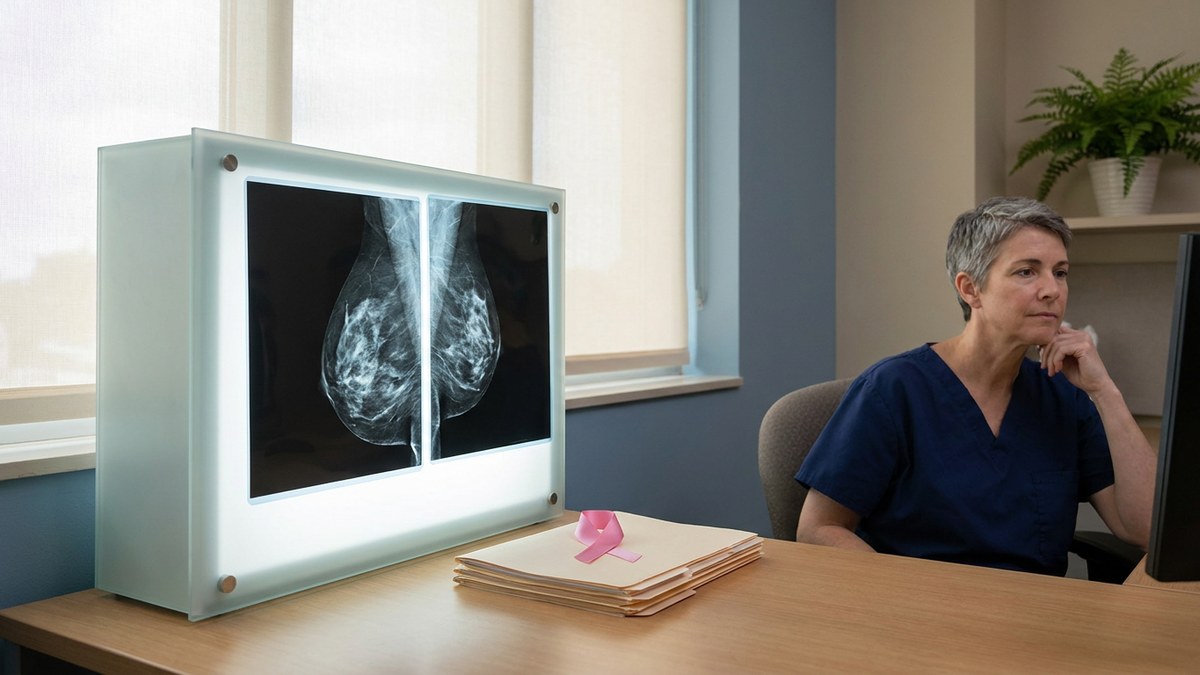
Interval breast cancers, those diagnosed between two screening rounds, tend to have a worse prognosis than tumours found by the mammogram itself. An analysis of the UK Breast Cancer Now Generations Study identifies which characteristics of a woman are associated with a higher risk of these tumours, a first step towards screening tailored to individual risk.
What was known
Mammography screening reduces breast cancer mortality, but it does not detect every tumour. Some cancers appear between two tests, often because the tumour grows quickly or because dense breast tissue makes it hard to see. High breast density was already known to be a breast cancer risk factor, but its specific role in interval tumours, alongside other reproductive and hormonal factors, was less well defined.
What this study adds
The authors analysed 1,940 women diagnosed with breast cancer between 2004 and 2018 in a UK prospective cohort linked to the national screening programme. Risk factors were recorded at enrolment, before diagnosis, and breast density was estimated from earlier mammograms in a subset of 1,191 cases. They compared 1,185 screen-detected cancers with 755 interval cancers, adjusting for age, time in the study, year of diagnosis, density and tumour characteristics.
Main results
Higher breast density was associated with later menarche, nulliparity, breastfeeding, previous benign breast disease, alcohol, lower body mass index and current menopausal hormone therapy. In the adjusted model, interval cancer risk was lower in overweight women (0.74; 0.58-0.93) and higher with density in the top quartile (2.13; 1.44-3.17), menopause at 55 or later (1.60; 1.02-2.50), current hormone therapy (1.41; 1.04-1.91), benign breast disease (1.36; 1.11-1.68), being underweight at age 20 (1.65; 1.14-2.38) and a family history of breast cancer (1.26; 1.00-1.58). Previous oral contraceptive use stood at 1.25 (0.93-1.69). The associations were independent of the tumour.
What it means
Breast density and several features of a woman’s hormonal and reproductive history raise, through separate pathways, the likelihood that a cancer will become apparent between two screens. These are observational data: they describe associations in a cohort, they do not predict an individual woman’s risk and they do not by themselves justify changing how often mammograms are performed. Their value lies in guiding risk-adapted screening, with supplementary imaging in the groups that accumulate more factors.
A view from the breast unit
Interval tumours deserve systematic review: knowing breast density and hormonal history helps decide whether supplementary imaging is worthwhile and helps explain why screening is not infallible.
Reference: Johns L, Brayley M, Frost R, Coulson P, Jones M, Berrington de Gonzalez A, et al. Breast density and risk factors for interval and screen-detected breast cancers: a case-case analysis of the Breast Cancer Now Generations Study, UK. Breast Cancer Research, 2026. DOI 10.1186/s13058-026-02355-z