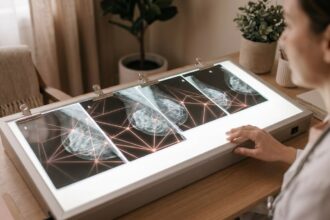
A study published in the Journal of Clinical Oncology concludes that malignancy scores generated by artificial intelligence (AI) algorithms on mammograms taken years before diagnosis, combined with breast density measures, contribute independent information for predicting long-term risk of invasive breast cancer, particularly advanced tumours.
What was known
AI algorithms have been shown to improve breast cancer detection on mammography, mainly by reducing false negatives and interval cancers. Until now, however, it was unclear whether that ability also translated into better long-term risk prediction: that is, whether the score an AI assigns to an apparently normal mammogram could anticipate which women would go on to develop advanced cancer or a tumour detected between screening rounds.
What this work adds
The researchers identified 2,412 women with invasive breast cancer and 4,995 controls matched on age, race and date of mammogram, drawn from two US screening cohorts. All participants had two-dimensional full-field digital mammograms performed 2 to 5.5 years before diagnosis. Breast Imaging Reporting and Data System density, an AI malignancy score on a 1-10 scale, and volumetric density measures were assessed. Conditional logistic regression was used to estimate odds ratios (OR) and 95% confidence intervals adjusted for age and BMI, along with C-statistics (AUC) describing the association between AI score and invasive cancer. Likelihood ratio tests and bootstrapping methods were used to compare model performance.
Main results
On mammograms performed 2 to 5.5 years before diagnosis, a one-unit increase in AI score was associated with 20% greater odds of invasive breast cancer (OR 1.20; 95% CI 1.17-1.22; AUC 0.63; 95% CI 0.62-0.64). Predictive performance was similar for interval cancers (OR 1.20; 95% CI 1.13-1.27; AUC 0.63) and advanced cancers (OR 1.23; 95% CI 1.16-1.31; AUC 0.64), as well as in dense breasts (OR 1.18; 95% CI 1.15-1.22; AUC 0.66). The AI score improved prediction of all cancer types in models that already included density measures (likelihood ratio test P = .01), although it did not reach statistical significance for interval cancer.
What it means
The findings suggest that the information AI extracts from a mammogram does not fully overlap with what breast density provides: the two capture different aspects of risk and, taken together, predict more accurately who will develop invasive cancer, especially advanced disease. This opens the door to risk models that combine AI-assisted reading and density to tailor screening intervals or consider additional imaging. It is worth stressing that this is a population-level prediction study, not an individual diagnostic tool, and that the authors themselves note the improvement for interval cancer was not statistically significant.
A view from the breast unit
For a breast unit, this work points to a future in which screening mammography does more than deliver a yes-or-no diagnosis, feeding instead into risk stratification embedded in the care pathway. Adopting it would require local validation, staff training and clear referral criteria before follow-up protocols are changed.
Reference: Impact of Artificial Intelligence System and Volumetric Density on Risk Prediction of Interval, Screen-Detected, and Advanced Breast Cancer. Journal of Clinical Oncology, 2023. DOI 10.1200/JCO.22.01153